
Webster Parole and Probation Compared
Parole and probation both allow a person to live in the community under rules, but they begin in different ways. The Georgia State Board of Pardons and Paroles grants parole as conditional release from prison before the maximum release point. The Georgia Department of Community Supervision, known as DCS, supervises people granted parole. A parole record therefore belongs in the state-prison and Parole Board lane, not the Webster jail roster lane.
Probation is imposed by a court after a plea or conviction. It can replace incarceration or form part of a split sentence, which combines custody with a period of supervision. For a Webster County felony case, the court file establishes the sentence and DCS provides community supervision. A local release on bond is neither parole nor probation by itself.
| Question | Parole | Probation |
|---|---|---|
| Who creates it? | Georgia State Board of Pardons and Paroles | The sentencing court |
| What precedes it? | A state-prison sentence and Board release decision | A plea or conviction, with or without time in custody |
| Who supervises it? | Georgia Department of Community Supervision | DCS for felony probation in the researched Webster path |
| Best public proof | Parolee Search, Board records, and DCS confirmation | Court sentence or order and DCS confirmation |
- Parole
- Conditional release from prison granted by the Parole Board before the maximum sentence endpoint.
- Probation
- A court-ordered sentence served in the community under stated terms.
- Supervision
- Monitoring and reporting duties carried out by DCS after release or as part of a sentence.
- Discharge
- The formal end of parole or probation obligations, not merely release from jail.
Verify Webster Post-Release Supervision
Begin by deciding whether the person left county jail, state prison, or neither. A Webster County detainee who bonded out is not automatically a parolee. Someone released from a Georgia prison may be on parole, but could also have completed the custodial term without parole. A person sentenced to felony probation may never have entered state prison. That custody history determines which record can answer the question.
- Search the Georgia Parole Board's public Parolee Search by first name, last name, and race, then match identity with care.
- For a person still being considered for release, check the Inmate TPM Lookup and read a tentative parole month only as tentative.
- Review the Webster County court file when probation, a split sentence, or sentence completion may apply.
- Use the DCS field-office locator to identify the office serving the person's supervision area.
- Confirm uncertain, changed, or completed supervision with DCS, the Parole Board, or the sentencing court.
The Georgia State Board of Pardons and Paroles provides the public entry points for parole consideration and parolee status. Its Parolee Search is not a jail roster or a GDC custody locator. A parolee can be out of prison and still appear because the record concerns supervision. By contrast, a person still shown as actively serving in GDC has not yet been released from state-prison custody.
Georgia VINE may send custody-change alerts when the holding agency feeds it, but VINE does not establish probation terms or confirm that supervision ended. For the complete released-person lookup across local, state, court, and federal lanes, use the Webster County released-inmate record paths.
Note: A release alert answers a custody question, while parole and probation records answer what legal supervision continues in the community.
Webster Supervision Routes Through DCS
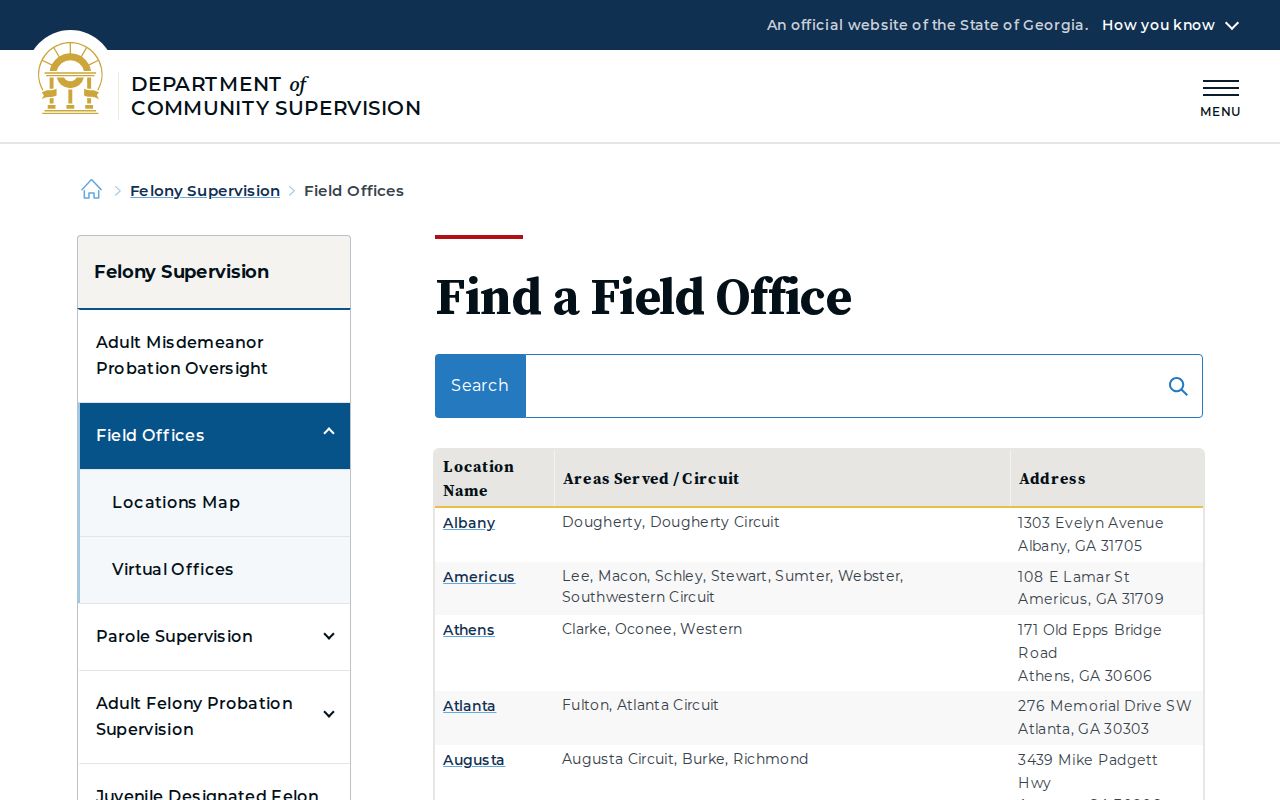
Webster County does not have a researched sheriff-run parole or probation desk. The correct route is the statewide Georgia Department of Community Supervision system. DCS supervises felony individuals in the community, including parole, reprieve, felony probation, and split-sentence populations. Its field-office locator routes Webster County inquiries through the Americus-area service structure.
The DCS field-office locator is the official source for the currently assigned office and its published contact details. No fixed Webster-specific DCS street address was documented in the research, so the locator should be checked rather than relying on an assumed office or sending a supervision question to the sheriff.
Service: parole, reprieve, felony probation, and split-sentence supervision
Webster routing: use the official field-office locator for the Americus area
Contact details and hours: confirm on the selected DCS office listing
DCS is the supervision contact, but it does not replace the sentencing court. When a question concerns what the judge ordered, the length of probation, or whether a term changed, obtain the court order. When it concerns reporting instructions or the office assigned to a supervised person, DCS is the proper agency.
Webster Parole Decisions and Timing
A Webster County case that results in state prison moves into GDC and Parole Board systems. The Georgia parole process allows the Board to set a Tentative Parole Month, deny parole, reconsider a prior decision, or grant release to parole. A TPM marks a month for final review and possible release action. It is not a guaranteed release date.
Good conduct and completion of required programs may affect a TPM. Misconduct or an unmet condition can postpone or cancel it. Certain life-sentence matters are handled through grant-or-deny decisions rather than the ordinary TPM framework. The Board's eligibility guidance and life-sentence information should be consulted for those cases instead of applying a general rule.
| Board result | Meaning |
|---|---|
| TPM set | A tentative review month exists, subject to conditions and final action. |
| Parole denied | The person remains in the prison sentence lane, with reconsideration governed by applicable rules. |
| TPM postponed or canceled | Conduct or unmet conditions changed the tentative path. |
| Parole granted | The person leaves prison under conditions and DCS supervision. |
O.C.G.A. § 42-9-45 supplies general parole-consideration timing, with exceptions. It describes misdemeanor consideration after six months or one-third of the sentence, and felony consideration after nine months or one-third, whichever is greater, unless another rule applies. Aggregate terms of 21 years or more have separate timing. Serious violent felony and repeat-offender statutes can add restrictions, so the broad timing rules should not be used to predict a Webster release date.
Webster Parole Hearings Are Statewide
There is no Webster County parole-hearing calendar to search. The Parole Board publishes meeting notices through its press-release channel and maintains an events page, but its monthly public meetings are not a courtroom-style docket for individual offender cases. A January 2026 notice stated that offender cases are not discussed or considered at those monthly meetings.
For an individual, the useful public tools are the Inmate TPM Lookup, Parolee Search, parole process material, and direct Board records. The events calendar had no upcoming events when researched. That absence should not be read as a parole denial or proof that no case review is taking place.
Can a family member attend a Webster parole hearing from a public calendar? The researched sources do not establish that route. Use the Board's case-status tools and published process, and contact the Board for case-specific participation procedures.
Webster Supervision Rules and Violations
Parole and probation conditions come from the release certificate, supervision rules, and court orders. Common duties can include reporting, following lawful instructions, and not absconding. To abscond means to stop reporting or evade supervision. The exact conditions must be read from the person's governing documents because a general agency page cannot state every Webster County term.
No statewide public DCS absconder or parole/probation warrant search comparable to a jail roster was found. DCS uses internal warrant and law-enforcement workflows, but those systems are not a public search service. An absent name in a parole lookup therefore does not prove that no warrant or violation exists.
Use the Parolee Search for public parole status, DCS for supervision verification, and Webster court or law-enforcement records for a filed violation or warrant when public access is lawful. A warrant is a court or authorized legal command. An alleged violation does not by itself show the final result, which may require a hearing, Board action, or court order.
Note: A person can remain released in the community while a supervision issue is reviewed, unless an agency takes that person into custody.
Correct Webster Supervision Records
Georgia uses record restriction for eligible criminal-history records under O.C.G.A. § 35-3-37. That process is distinct from changing a parole, probation, court, or sheriff record. A reader should first identify which record contains the disputed item. The correct agency may be the Webster Sheriff's Office, the sentencing court, GBI, DCS, GDC, or the Parole Board.
The GBI record-restriction guidance explains an important date split. Arrests after July 1, 2013 generally route through the prosecutor rather than a GBI application. For arrests before that date, the process begins through the arresting agency. Restriction can change public access to qualifying criminal-history information, but it does not mean every court or supervision record is erased.
A supervision status that appears wrong should be raised with the agency that maintains it. Court sentencing terms belong with the court. Parole status belongs with the Board, and assigned supervision belongs with DCS. Keeping these record types separate prevents a request for one system from being misdirected to another.
Webster Supervision Ends by Discharge
Leaving jail or prison starts community supervision in many cases; it does not end it. Parole continues until the Board or governing record establishes discharge. Probation continues for the court-ordered term unless the court changes it or the responsible authority records completion. Discharge is the formal end of supervision duties.
To verify completion, seek the discharge document, court order, or official agency status. A past release date only proves that a custody event ended. It does not show that parole or probation ended on the same day. Likewise, disappearance from a public search is not a substitute for a discharge record.
The durable trail may include a sentencing order, supervision record, Board action, and final discharge. Keep the person's identifiers and case number available when asking DCS, the court, or the Parole Board to distinguish similar names and separate multiple cases.
Public Record Search
Sponsored Results